• Home
  • About Us
  • Toolkit
  • Archives
  • Advertise
  • Privacy Policy

Kids Ain't Cheap

But They Sure Are Worth It

  • Parenting
    • Baby Stuff
    • Books and Reading
      • Aesops Fables
      • Comic Books
    • Education
    • Family Time
    • Green Living
    • Growing Up
    • Healthy Living & Eating
    • Holidays
    • Parenting
    • Random Musings
    • Shopping
    • Stuff to Do
  • Money
  • Product Reviews
    • Books and Magazines
    • Discount Sites
    • Furniture
    • House Keeping
    • Reviews News
    • Toys and Games
  • Contact Us
  • Our Editorial Commitment
  • Search

Low-Cost After School Activities for Kids

March 26, 2020 | Leave a Comment

More and more, parents are not content to let their kids stay home after school watching TV and playing video games.  Instead, they want their kids to be involved in activities that will help them grow and learn more.  Being involved in activities helps children’s personal development, but it will also help improve their college admission chances because colleges routinely look for well-rounded students who are not only strong academically, but are involved in a variety of activities.  However, most parents struggle to find appropriate activities because they are intimidated by the high price tag of some activities like playing an instrument or horse back riding.  If that is your concern, keep in mind that there are many low-cost after school activities for kids.
Low-Cost After School Activities for Kids

Low-Cost After School Activities for Kids

The following are great places to start when you’re searching for after school activities:

School Based Activities

The first place to look for low-cost after school activities for kids is at your child’s school.

Sports

Your child’s school likely offers a host of sports from football to baseball to volleyball to swimming to track and field.  Some of these sports will be completely free to participate in and others will require some equipment and perhaps some fund raising participation.

Many kids participate in one sport per season and stay very busy and active with that schedule.  Even better, they stay physically fit!

Clubs

Likewise, after school clubs are usually free.  When my son was younger, he participated in choir and art club, each of which met one time per week.  Now that he’s in high school, he joined the Model U.N. Club, which also meets once a week.

Depending on the size of your child’s school, there are likely to be a handful of clubs or many more.  Likely she can find one she wants to participate in.

Library Based Activities

Many people don’t consider the library when looking for low-cost after school activities for kids, but it’s a great place to look!  Our local library has many activities for kids and teens as I’m sure yours does also.

Games

Our library has a game night once per month, but there are also other get togethers for such things as Minecraft and Legos.

Chess Club

Low-Cost After School Activities for Kids
Photo by Wim van ‘t Einde on Unsplash

Once a month, our library has a chess club meeting.  Kids can bring a chess board and play against one another for two hours.  I’m always surprised to see how many kids are there.  Upwards of 20 to 25 kids come to play chess.

Teen Advisory Board

In our area, each local library hosts a teen advisory board once or twice per month.  All participants must be 13 to 18 years old.  Together, they help organize activities for the library, and they also have the option to volunteer when the library hosts activities.  Some weeks, they also do fun things such as receive specialized art lessons or do something good for the community like make cards for seniors.

Girl Scouts/Boy Scouts

Girl Scouts or Boy Scouts is another option.  You will have an initial upfront fee to buy the uniform and the book.  This runs about $80 to $100.  Then, there are fees for camping events and badges, so this isn’t the cheapest activity around.

However, by joining the Scouts, your child could keep quite busy between attending the meetings, going on camping trips and other outings, and working on badges.  Many adults fondly remember their time in scouting and say they learned a great deal that helped shape their lives.

Parks and Recreation Activities

Have you looked at your local parks and recreations or community center activities?  Depending on the area that you live in, you could find many activities from sports to arts and crafts.

My kids have regularly taken advantage of parks and recreations activities.  My son took swim lessons there, and my daughter has participated in several crafting classes as well as a gymnastics class when she was little.  What I love about activities through the parks and recreation or community center is that they’re low cost.  Depending on the activity, you pay $20 to $40 for a six-week class, and most supplies are included.

A word of warning, though.  Since these classes are such a bargain, they typically fill up quickly.  To be able to get a seat for your child, you may have to sign up early on the day that registration begins.

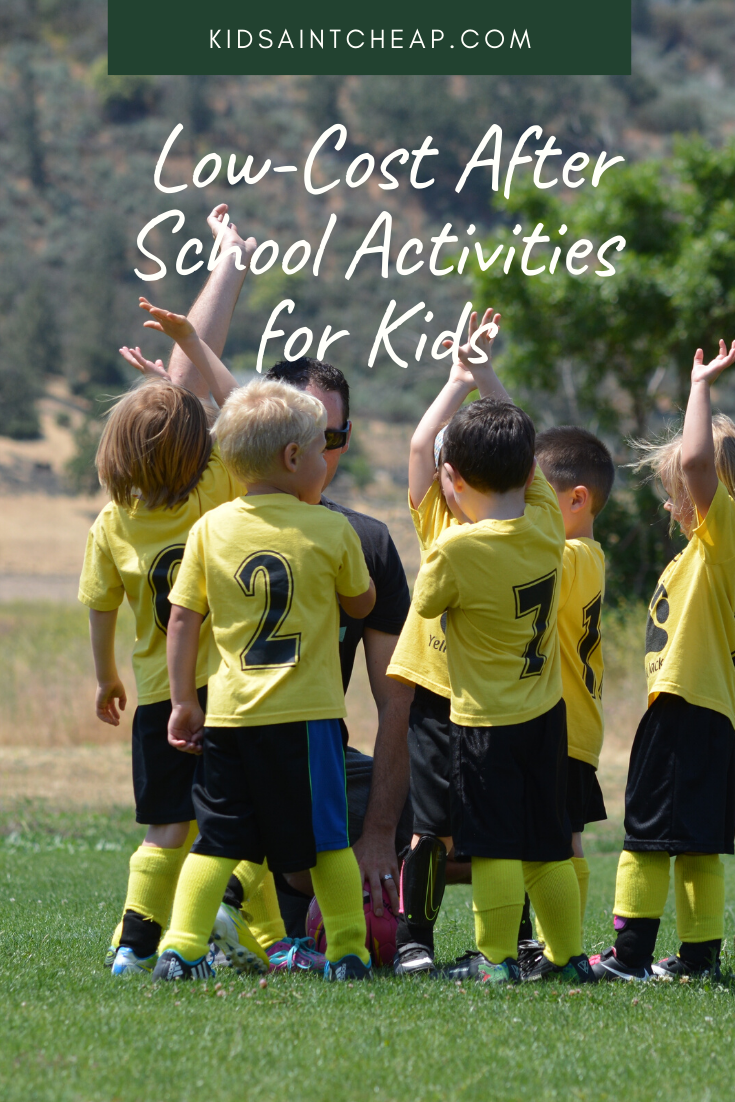
AYSO

One activity canvasing the United States is the American Youth Soccer Organization (AYSO).  AYSO is open to both boys and girls from three to 19.  There is an initial joining fee, and you’ll be required to sometimes bring snacks for the team.  You’ll also need to buy the proper equipment such as shin guards and cleats, but these can be bought second hand at a used sporting goods store.

Once your child joins AYSO, you can expect him to have practice two times per week (perhaps more depending on his age), and to have one game a week.  My son joined AYSO and had a wonderful coach, but when we played against other teams, I saw some less than stellar coaches that berated their players.  Make sure you have a coach who encourages and supports the children.

Church Groups

If you belong to a church, consider having your children join some of the church activities.  My daughter sings in our church choir and attends practice once a week.  My son is part of the teen group.  The teen group meets once a week for 1.5 hours, and they also participate in service activities and weekend retreats.

Church activities are typically free except for special events like retreats.

Final Thoughts

If you’re looking to get your child in an activity or two but you’re worried about the cost, rest assured that there are many low-cost after school activities for kids.  You’ll be glad your kids are more involved, and your kids will likely enjoy being out with friends doing something fun.  Plus, you’ll be laying the groundwork for college admissions, if that’s something your child wants to pursue in the future.

Melissa Batai
Melissa Batai

Melissa is a writer and virtual assistant. She earned her Master’s from Southern Illinois University, and her Bachelor’s in English from the University of Michigan. When she’s not working, you can find her homeschooling her kids, reading a good book, or cooking. She resides in Arizona where she dislikes the summer heat but loves the natural beauty of the area.

Read More

  • 8 Gut Feelings Parents Ignored—and Paid the Price

    Image from Unsplash There’s something primal about it—an uneasy feeling, a flutter in the chest,…

  • Parents, children and family with playing on sofa, tablet and bonding with love, joke or funny memory in living room. Mother, father and kids with games, app and connection to relax on couch in home.
    Your Child Watched You Do One of These 7 Things, And It Changed Their Life

    Image Source: 123rf.com Children are like sponges, soaking up everything they see and hear—especially from…

  • A Lesson in Humility, Understanding and Forgiveness
    A Lesson in Humility, Understanding and Forgiveness

    This was absolutely not the post I had planned on writing this week. You see…

  • Discover the Best Mini Cribs of 2024
    Discover the Best Mini Cribs of 2024

    In the quest for the perfect nursery setup, the size and functionality of the crib…

  • Hosting a Bridal Shower on a Budget
    Hosting a Bridal Shower on a Budget

    I think most of us have at least attended a shower before. Baby showers and…

  • How To Use Governmental Resources for Inexpensive Speech Therapy for Kids

    123rf Speech therapy is essential for children who struggle with communication challenges. However, the cost…

Filed Under: Money and Finances Tagged With: Activities, after school activities, extracurriculars, Sports

Leave a Reply Cancel reply

Your email address will not be published. Required fields are marked *

This site uses Akismet to reduce spam. Learn how your comment data is processed.

  • Facebook
  • Pinterest
  • RSS
  • Twitter
Best Parenting Blogs

Most Popular

Baby

9 Baby Names That Sound Expensive Even Though Naming Your Baby Is Still Free

Evan Morgan
Baby

The Rise of “Aggressive” Baby Names Is Raising Eyebrows — Here’s What Parents Are Choosing

Evan Morgan
Baby names

Teachers Admit: These 6 Baby Names Create Instant Bias in the Classroom

Latrice Perez
6 Baby Names That Sound Cute Now but Cause Problems Later

6 Baby Names That Sound Cute Now but Cause Problems Later

Brandon Marcus
11 Ways Kids Are Outsmarting Parental Controls 1. Using Alternate Devices One common trick is simply turning to another device. If a child’s main phone or tablet is restricted, they may borrow a sibling’s, friend’s, or even a school laptop. This instantly gives them access to content outside of parental oversight. Parents often focus on one device, forgetting that others in the household can serve as loopholes. Knowing this tactic helps families tighten controls across all electronics. 2. Clearing Browsing Histories Many kids quickly learn that clearing browsing history hides evidence of restricted activity. With just a few clicks, they can erase any trace of websites visited. This makes it harder for parents to notice when rules are being broken. Parents may assume no history means no browsing, but the reality is often the opposite. Kids are outsmarting parental controls by making it seem like nothing happened at all. 3. Using Private Browsing Modes Most browsers offer “incognito” or private browsing features. Kids use this mode to access websites without leaving a record in the history. To parents checking later, everything looks clean and safe. This simple trick is often one of the first ways kids discover how to bypass restrictions. Conversations about private browsing can help close this gap. 4. Guessing or Resetting Passwords Children who are persistent may try to guess passwords to parental control apps or accounts. Others may find ways to reset them through email prompts or security questions. Once inside, they can disable restrictions entirely. Parents may not even realize controls have been altered until much later. Stronger, less predictable passwords can make this more difficult. 5. Using VPNs to Hide Activity Virtual private networks, or VPNs, let kids disguise their online locations. With one downloaded app, they can bypass geographic or parental restrictions. Some children learn about VPNs through friends or even social media. This makes it easy for them to reach content that should be blocked. Parents often underestimate just how simple it is for kids to use these tools. 6. Creating Fake Accounts When parents monitor social media, kids may create hidden accounts. These “finstas” or fake profiles allow them to interact freely without parental oversight. While their main account appears harmless, the secondary one tells a different story. Kids are outsmarting parental controls by playing both sides at once. Checking for duplicate accounts can help parents stay more aware. 7. Exploiting Time Zone Settings Some kids change the time zone on their devices to bypass screen time limits. This trick allows them to gain extra hours of usage undetected. Parents may assume controls are working, but in reality, the child is bending the clock. It’s a clever loophole that highlights just how resourceful kids can be. Monitoring device settings regularly can catch this tactic. 8. Disabling or Uninstalling Apps Parental control apps can be deleted or disabled with surprising ease. Some kids even reinstall them before a parent checks, making it seem like nothing changed. Others may simply restrict permissions to prevent apps from functioning properly. When apps aren’t monitored closely, parents may not notice they’ve been tampered with. This shows the importance of consistent follow-up. 9. Turning to Friends for Access If a child can’t get past restrictions on their own, they may rely on friends. Visiting a friend’s house or borrowing their phone can give them a free pass. Parents often forget that peer environments can override restrictions set at home. This kind of social workaround is especially common with gaming or social media. Open conversations about trust and responsibility are essential. 10. Hiding Apps in Plain Sight Kids sometimes download apps that look innocent but serve as gateways to hidden activity. These apps may disguise themselves as calculators or utilities. In reality, they allow file storage, private messaging, or browser access. Parents glancing at a home screen may overlook them entirely. Learning to recognize these disguised apps can help parents stay informed. 11. Outpacing Parents’ Tech Knowledge Finally, kids often know more about devices than their parents do. Whether through YouTube tutorials, TikTok hacks, or peer groups, they quickly learn advanced workarounds. This knowledge gap means controls can be bypassed before parents even realize the loophole exists. Staying informed and continually learning about new technology is the best defense. Kids are outsmarting parental controls because they adapt faster than most adults. The Real Solution Lies Beyond Restrictions While controls and filters are important, no system is perfect. Kids will always find creative ways around barriers, making communication the strongest safeguard. Setting clear expectations, building trust, and having ongoing conversations about online behavior matter more than apps alone. Parents who combine technology with open dialogue create a safer digital environment. The goal isn’t to win a battle of wits but to build a relationship that keeps kids both safe and honest. Do you think kids are outsmarting parental controls faster than parents can keep up? Share your experiences in the comments below. What to Read Next... 6 Parenting Tech Shortcuts That Can Expose Your Child to Strangers How Much Screen Time Is Too Much—Legally Speaking? Is Your Child’s School Quietly Tracking Their Location Without Your Consent? How Much Screen Time Is Quietly Reshaping Childhood Behavior? Why Some Parents Are Being Investigated Over Homeschooling Records

11 Ways Kids Are Outsmarting Parental Controls

Catherine Reed

All content on Kids Ain’t Cheap is for entertainment purposes only. By reading this blog, you agree that Kids Ain’t Cheap is not responsible for any actions taken after reading this blog. For the full disclaimer, see our privacy policy.

Please note that Kids Ain’t Cheap has financial relationships with some of the merchants mentioned here. Kids Ain’t Cheap is funded by banner advertising, commission sales and search optimization consulting.

Copyright © 2006–2026 | District Media | All Rights Reserved | Privacy Policy

Copyright © 2026 Runway Pro Theme by Viva la Violette